
 Indonesia
 English



.jpg)
In this rapidly evolving digital age, new things often emerge that spark a child’s curiosity. One of the most intriguing things right now is the drone.
Perhaps until now, we’ve only known drones as devices for taking photos from high up or simply as “high-tech toys.” However, if we take a closer look, this object we call a flying robot actually holds extraordinary potential to become a child’s learning companion.
It’s not just about flying through the air; this technology is a magical bridge that invites children to explore in a much more exciting way—from developing dexterity and sharpening focus to learning to solve problems in a fun way.
Let’s explore further how this technology can help children learn in a much more exciting way!
What Are Drones for Kids?
Have you ever seen the look of wonder on your little one’s face when they see a bird or an airplane flying in the sky? Their curiosity about the world from above can now be explored in a fun way through drones.
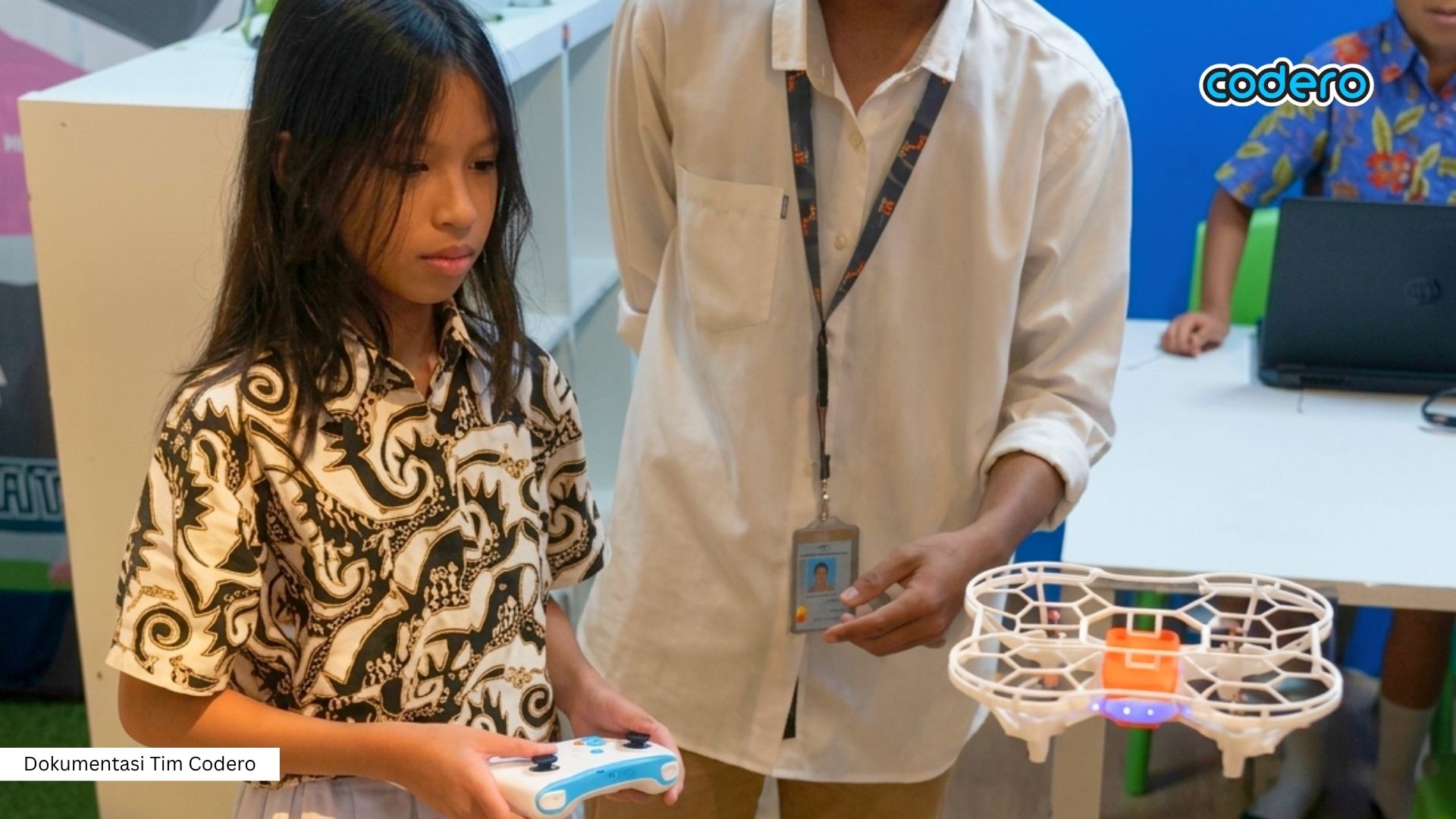
Simply put, a drone is a smart flying machine that we often refer to as a “flying robot”. Unlike our image of large, complex machines, drones designed specifically for children and teens are actually quite adorable. They’re lightweight, tiny (some are even palm-sized), and incredibly easy to fly.
More than just a toy
Child-friendly drones typically weigh only about 50 to 150 grams—as light as a small stack of letters! Yet, behind their tiny size lies great value. This technology serves as a fun learning tool to spark children’s curiosity and creativity from an early age.
When is the right time to start?
Many experts recommend age 8 and up as the ideal time for children to start controlling these flying robots independently. By this age, their finger dexterity and focus are usually well-developed.
However, don’t worry if your little one, aged 5–6 years, is already getting curious. They can still start getting acquainted with drones indoors, of course using very safe models and always under Mom and Dad’s watchful eye.
What Are the Benefits of Drones for Children?
Drones aren’t just cool gadgets; they’re “magical” learning tools that offer a variety of real benefits for children’s growth and development:
1. Learning science in a fun way
Instead of poring over thick textbooks, drones help kids understand science in a tangible way. They’ll learn how wind works, what gravity is, and even estimate distance and speed.
All of this happens while they pilot their flying robots, making science feel like a magical game.
2. Sharpening creativity and imagination
Drones give kids the chance to see the world from a perspective they’ve never imagined before. Through the attached camera, they can experiment with being young photographers or short-film directors.
This is an amazing way to sharpen their creativity and how they tell stories through images.
3. Developing agility and quick thinking
Controlling a drone in the air requires excellent hand-eye coordination. Children will learn to react quickly to keep their drone stable. If they encounter obstacles while flying, they are encouraged to stay calm, think clearly, and find solutions.
Indirectly, this builds a never-give-up attitude and independence from an early age.
4. Preparing for Future Careers
Learning about drone technology early on is a valuable asset for their future careers. Today, drones are used in a wide range of extraordinary fields—from helping farmers water crops and delivering packages to serving as heroes in disaster relief missions.
By playing with drones, children are preparing to be part of a highly advanced future.
5. Learning about patience and teamwork
Flying a drone certainly has its challenges. Sometimes it crashes or is hard to control. This is where the child’s patience is tested. They learn that failure is part of the process toward success.
When playing with friends, they also learn about the joy of sharing the sky and working together as a team.
Parents, giving your child access to the right technology is the best investment in their future. With loving guidance, drones are no longer just “toys in the sky,” but a real step toward helping your little one grow into a creative, resourceful person who’s ready to take on the world’s challenges.
Let’s watch together just how high your little one’s dreams can fly today!
.jpg)
.jpg)
.jpg)
.jpg)
