
 Indonesia
 English



.jpg)
Amidst the rapid advancement of technology today, the biggest challenge for parents is no longer keeping gadgets out of their children's reach, but rather directing their interests in a more meaningful way. We want our children to not only be passive consumers of technology, but active creators. Imagine if the time usually spent simply watching could be transformed into a process of designing the future. Let's explore how to transform digital habits into investments in our children's achievements.
Screentime: Between Parents' Concerns and Their Children's Hidden Potential
Behind the glowing screen in their children's hands, parents often harbor concerns. We all feel it the dilemma of seeing our little ones so engrossed in their own world behind a tablet or smartphone.
Technological advances have indeed changed the way children learn and interact. However, this double-edged sword begins to show its sharp side when screentime or the duration of digital device use is excessive without clear boundaries.
Studies reveal that uncontrolled gadget use, especially during the golden years, is not just a matter of eye strain. Beyond that, it can lead to decreased attention span, delayed speech, and challenges in managing emotions. Balancing digital life with physical and mental development needs is our primary mission as parents today.
Turning the Tables: Transforming Passive Consumption into Innovative Creation
The question then arises: is the solution simply to ban or remove gadgets altogether? In this era of AI, such measures may seem irrelevant.
There is a much more powerful middle ground: shifting children's role from passive consumers to creators of technology.
Through coding, we encourage children to no longer be passive video viewers or game players. We are opening the door for them to “look behind the screen”—to understand how technology works, not just how to use it.
Imagine the joy on children's faces when they successfully build their own ideas, create animations, and even develop applications that are purely born from their imagination. This activity transforms what was once an “empty” digital adventure into a deeply meaningful experience.
Every minute spent in front of the screen is no longer wasted time, but an investment in turning ideas into reality. Here, gadgets are no longer the enemy, but tools for children to create digital works they can be proud of.
Building Your Child's Future: 5 Amazing Benefits of Learning to Code for Their Growth and Development
Parents are certainly aware that in today's fast-paced world, technology is no longer just a tool, but the environment in which our children grow up. However, did you know that behind the computer screen, there is an extraordinary process that shapes your child's character and intelligence?
Learning coding is not just a current trend. It is a long-term investment to equip children with the “navigation” skills they need in life. Let's dive deeper into the extraordinary skills that will grow within them:
1. Instilling the mindset of a “solution architect”
Through coding, children not only learn to type commands, but also learn computational thinking. They are encouraged to look at a big, complicated problem, then calmly break it down into small, simple steps. This ability to think logically and systematically is a foundation that will help them solve any challenges at school and in their daily lives later on.
2. Unleashing unlimited imagination
We often see children engrossed in their gadgets. With coding, we encourage them to move up a level: from mere consumers to creators. Coding encourages children to think outside the box, find unique solutions, and turn their magical ideas into real works of art, such as original games or animations of their own creation.
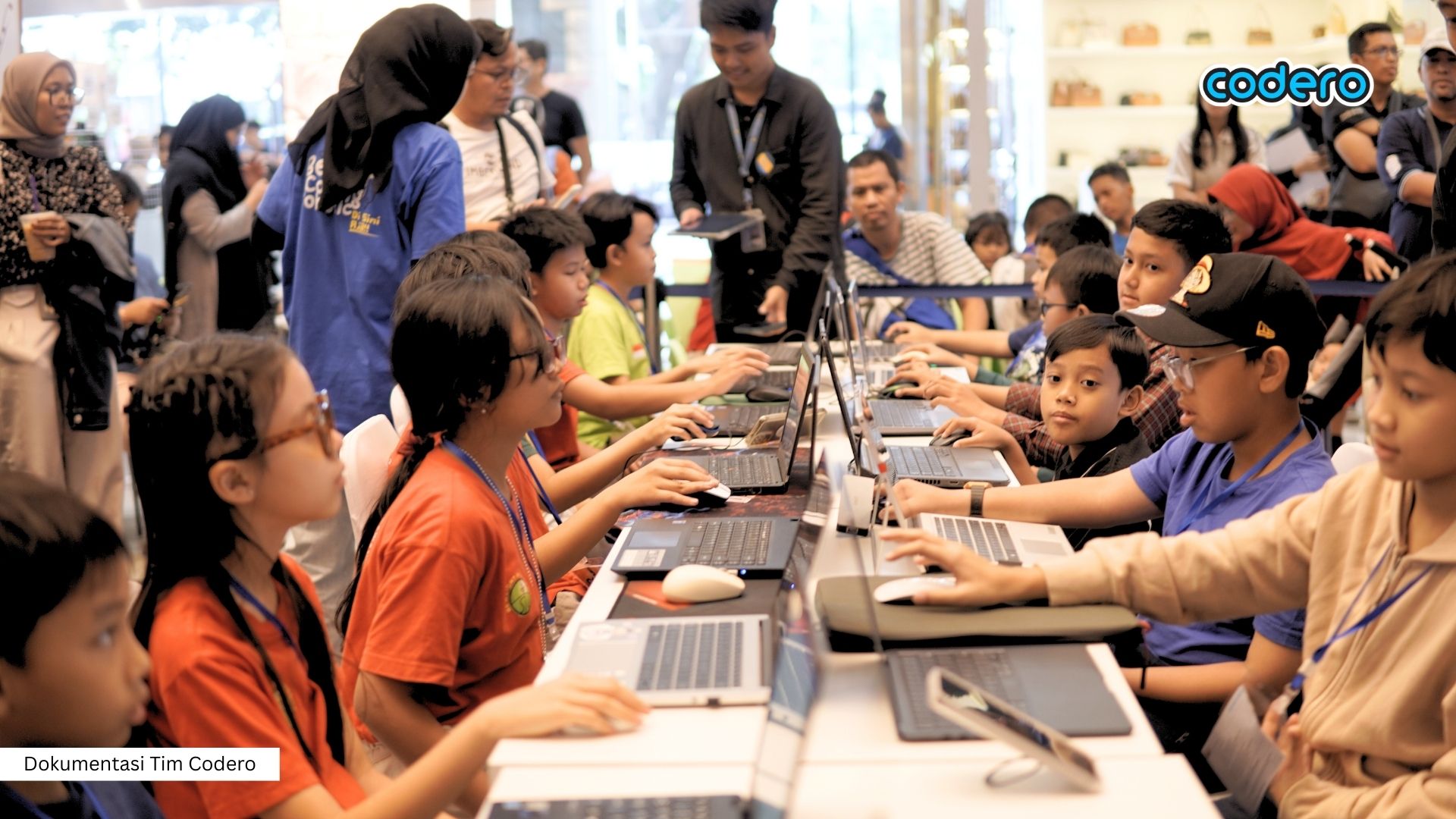
3. Developing a “never give up” mentality
In the world of coding, a mistake or bug is not a failure, but a puzzle. The process of debugging (finding and fixing errors) naturally trains children's resilience or mental endurance. They learn that falling is normal, but getting up and trying new ways until they succeed is the real key to success.
4. Making math feel more “alive”
Many children find mathematics boring because it feels abstract. However, when learning coding, the concepts of numbers, logic, and algebra suddenly become concrete and fun. Children can see firsthand how a mathematical formula can move a robot character or change the color of the screen. Suddenly, mathematics is no longer the enemy, but a friend in creativity.
5. Hone empathy through collaboration
Parents may imagine coding as a solitary activity. In fact, in our classes, coding projects often become teamwork opportunities. Children learn how to communicate their ideas clearly, appreciate their friends' contributions, and understand that great work is born from a combination of many minds. These are the soft skills that will make them excel in any social environment.
When is the Best Time for Children to Learn About Coding?
Perhaps one afternoon, parents were amazed to see how deftly their children operated their smartphones. A question arose in their minds: “When is the right time to introduce them to the ‘behind the scenes’ side of this technology?”
Experts suggest that age 7 is the ideal time for children to start learning coding in a structured way. However, this journey can actually begin earlier. Between the ages of 5 and 7, children can already be introduced to “logic” through visual puzzles and exciting interactive games.
At this stage, we are not training professional software developers, but rather planting the seeds of curiosity and problem-solving skills.
The flexibility of learning from home
We understand how busy parents are. The good news is that learning to code is no longer tied to a rigid physical classroom. Through Codero Online, children can explore the world of technology from the comfort of their own homes.
Here, coding is not presented as a difficult subject, but rather as a medium for exploration. Children are encouraged to create works, from simple animations to exciting projects that make them feel, “Wow, I can do this myself!”
Accompanying children's steps, from ages 4 to 17
Every child has their own growth rhythm. That's why Codero Online classes are designed to be inclusive for ages 4 to 17. With the support of professional mentors, children will be guided to:
Tell stories through technology: Express their hobbies and interests through digital creations.
Envision the future: Discover a wide range of career opportunities—from game developers to artificial intelligence (AI) architects—in a simple yet impactful way.
More than just theory, it's about confidence
For us, learning to code is an investment in character. In every line of code they write, there is honed logic, creativity that breaks boundaries, and most importantly: the confidence that they can conquer the challenges of the future.
Parents, let's help our children transform. Not just to become passive users of technology, but to become young innovators who are ready to shape the world.

.jpg)
.jpg)
.jpg)
.jpg)
