
 Indonesia
 English



.jpg)
Have you ever found your home suddenly quiet, with only the sound of music from your child's games or videos on their tablet? On the one hand, we may be amazed at how deftly our children's fingers operate digital devices that sometimes seem complicated even to us. However, on the other hand, there is often a twinge in our hearts that makes us wonder: “Why does my little one seem to have their own world behind that screen?”
This concern is very natural. We all want to give our best, but the rapid flow of technology sometimes makes us feel like we are racing against time.
But what if we see the screen not as an “enemy,” but as a window of opportunity?
In fact, your child's proficiency in operating technology is an extraordinary starting point. The problem is not the technology itself, but what they do with it. Until now, your child may have only been a consumer of other people's work.
This is where our role as their loyal companions comes in. Let's encourage our children to level up, from being passive spectators to active creators. Imagine how proud our children (and of course, their parents) will be when they realize that technology isn't just for playing around with, but can be used to create their own amazing works.
Why Are Children So Fascinated with Technology?
Many parents feel guilty when they see their children “addicted” to gadgets, but there are actually scientific and environmental reasons behind this:
1. The brain's “reward” system (dopamine)
Have you ever felt happy when you were praised? Children's brains feel the same way when they successfully pass a level in a game or watch a colorful video. In their brains, there is a “happiness signal” that lights up every time they get that instant gratification.
Children's brains register this feeling of pleasure and naturally ask to feel it again and again. That's why stopping playing feels like missing out on a fun moment.
2. Captivating technology design
We need to realize that many apps and games are designed by experts to be “digital magnets.” From the melodious sound of victory to the ever-changing display, everything is deliberately made so that anyone, especially children, will want to stay longer. These features are like constant invitations that tempt your little one to stay in the virtual world.
3. Imperfect control over desires
One thing we often forget is that children's brains are still developing rapidly. The part of the brain responsible for “braking” or restraining the desire to stop learning is not yet as fully functional as in adults.
So, when they find it difficult to stop, it's not because they are naughty, but because the “braking system” in their minds is still developing. They need gentle help from their parents to learn when to press the stop button.
4. Lack of interesting alternatives
Sometimes, gadgets become the main choice simply because children feel confused about what else to do in the real world. Screens offer unlimited instant adventures. If there are no alternative activities around them that are just as exciting, then turning to technology becomes the easiest way to ward off boredom.
Educational Activities to Make Screen Time More Meaningful
Seeing your little ones glued to their gadget screens often makes us worry, right, parents? However, in this digital age, the key is not to completely remove technology, but to guide them so that they are not just viewers, but creators.
Let's turn our children's leisure time into moments of exploration that are full of benefits with the following exciting activities:
1. Explore creative technology (geeky pursuits)
Moms and Dads can start introducing your children to the world of simple robotics or making short stop motion films using their favorite toys. These activities are like “conjuring” technology into magical tools. From this, your child learns that screens are not just a place to view other people's work, but a place where their own original work is born.
2. Science projects at home
Use simple ingredients from the kitchen to conduct science experiments, such as mixing vinegar and baking soda. This is great for sparking curiosity and problem-solving skills.
3. Building with LEGO
Games such as LEGO are an excellent investment in finger dexterity and imagination. When your little one puts these blocks together, they are actually learning to be the architect of their own ideas, practicing patience, and understanding how a large structure is built from small pieces.
4. Accompany them with high-quality content
If your child needs to use digital devices, choose high-quality educational applications. Most importantly, be an engaging “viewing companion.” Ask them what they are watching and relate it to real life. That way, technology becomes a bridge of communication between parents and children.
Parents, the key is not about opposing technology, but about finding balance. By setting consistent boundaries and providing alternative activities that stimulate creativity, we can help children grow into intelligent individuals in the digital age without missing out on precious moments in the real world.
What Makes Learning at Codero Different?
If you are still confused about how to start guiding your child's interest in digital technology, Codero is here to help. We believe that every child has the potential to become a future innovator.
At Codero, we don't just provide boring theory. Instead, we offer exciting practical experiences to nurture children's logic, creativity, and confidence.
A space for storytelling
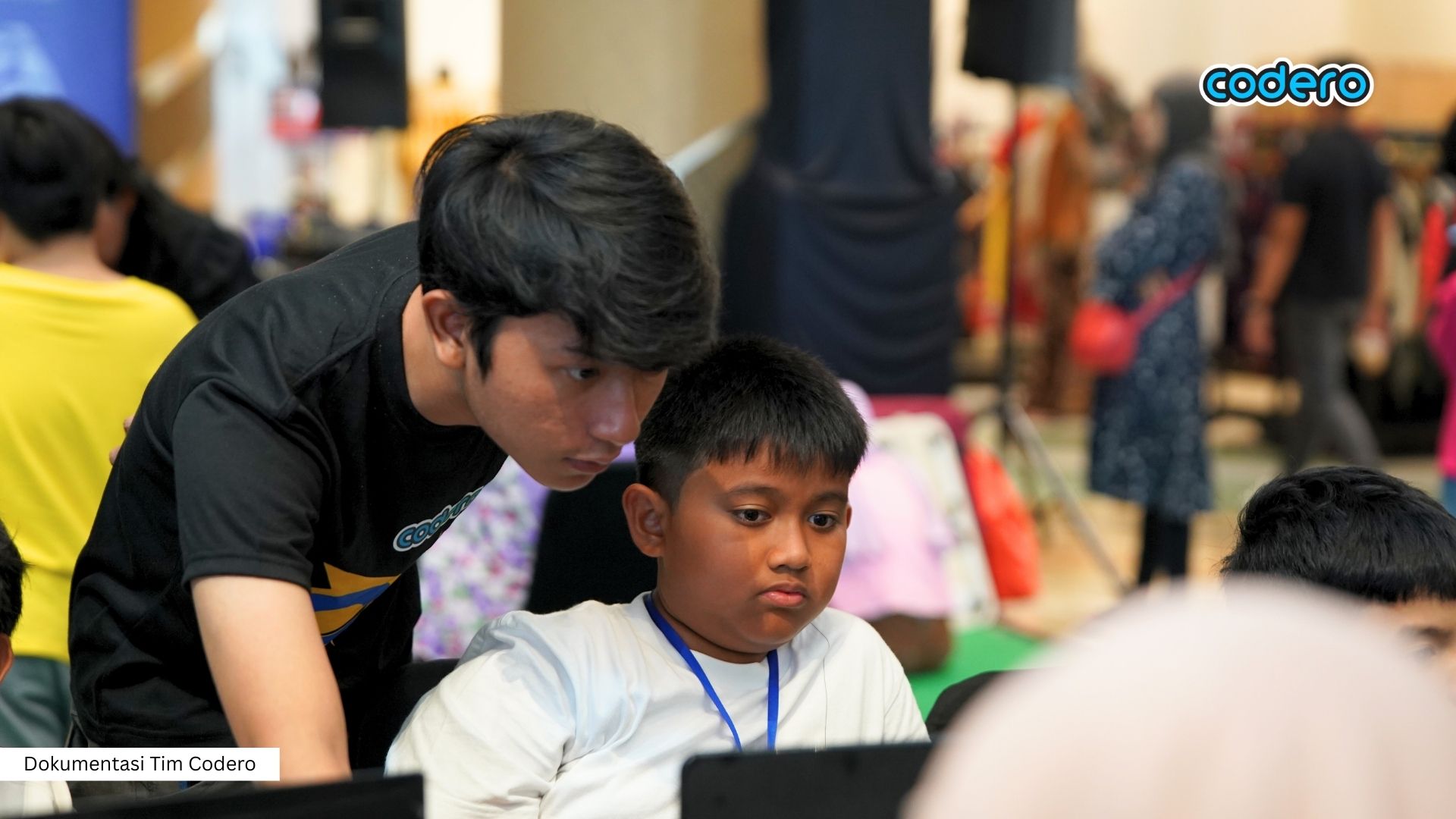
Our mentors are not just teachers, but discussion partners who are ready to listen to children's hobbies and interests, then translate them into real technology projects.
Understanding the challenges of the future world
We introduce career opportunities in IT, such as game developers and robotics experts, using simple and easy-to-understand language.
Child-friendly curriculum
From ages 4 to 17, everyone can join! We have developed systematic learning steps so that even children who have never used a laptop before can happily participate.
Here, mistakes are not failures, but important steps in the learning process. With the guidance of patient and supportive mentors, children are encouraged to try new things, think critically, and solve problems through engaging projects.
All you need is a laptop and a stable internet connection, and parents can provide a meaningful “digital adventure” right from home. Let's help children leap from being mere users to creators with Codero.
.jpg)
.jpg)
.jpg)
.jpg)
