
 Indonesia
 English


.jpg)
Imagine a child in elementary school with an overflowing curiosity about how machines work, but all he can see are pictures in a worn-out book. That is the real challenge we face today: the gap between the needs of the digital industry and the readiness of our schools.
As fellow drivers of change in the field of CSR, you surely understand that this challenge cannot be solved alone. The high cost of robotic infrastructure and uneven curricula are major obstacles for them. However, this is where the magic lies. Through targeted cross-sector collaboration, we can break down these barriers. Let's discuss together how the real contributions of your companies can be catalysts for creating a golden generation for Indonesia.
Bridging the Digital Divide: Understanding the Reality of Implementing Coding and Robotics in Elementary Schools
Envisioning children in remote areas of the country becoming proficient in logic through lines of code and robotics is a big dream that we want to realize together. However, on the journey towards the digitization of education, we often encounter challenging realities.
As individuals who care about the future of education, understanding these obstacles is the first step in ensuring that the CSR programs we build do not merely give, but truly grow.
Here is a snapshot of the challenges we need to face with more precise strategies:
1. Aligning abstract logic with the world of children
For elementary school students, the world is what they can touch and see. Meanwhile, coding is often hidden behind abstract concepts such as algorithms and complex variables. There is a huge gap between children's cognitive development, which is still in the concrete operational phase, and the complexity of programming language.
The challenge for us is how to simplify this “complexity” into a meaningful game for them.
2. Empowering teachers as the spearhead
We cannot expect major changes if the drivers in the classroom feel like they are walking alone. Many fellow teachers are highly motivated, but feel less confident due to their limited technical background.
Without ongoing guidance and training, even the most sophisticated technology will end up as nothing more than a display in the school closet due to teaching methods that tend to be rigid and boring.
3. Breaking down barriers of accessibility and cost
We must admit that investing in high-quality robotic devices and sensors is still a luxury for many schools. However, the real obstacles are often more fundamental than that: unstable electricity and uneven internet access.
This is where our strategic role is tested—how to design inclusive programs so that these innovations are not only enjoyed by those in the city center, but also reach those on the periphery.
4. Creating sustainability in the curriculum structure
Often, coding and robotics learning in schools only appear as a fleeting spark—becoming an additional or extracurricular activity that is not standardized. Without clear and integrated curriculum guidelines, the impact we plant risks being lost when the program ends.
We need to ensure that this initiative is not just a “temporary project,” but an integral part of the students' learning journey.
Behind the Lines of Code: Why Collaboration is the “Spirit” of Robotics Education
Many people imagine coding or robot assembly as solitary activities—a child glued to a screen all by themselves. However, for those of us involved in community development, we understand that technology is only a tool. The real power lies in how that technology brings creative ideas together to create solutions.
In every technology education CSR program we run, collaboration is not just a complement, but the main foundation. This is why teamwork is the most valuable investment for their future:
1. Bringing the 4C ecosystem to life in students
We are not just training technicians, but future leaders. Through robotics projects, students not only learn syntax, but also organically hone their communication, collaboration, critical thinking, and creativity skills. When they sit together discussing the direction of the robot's movement, that is where their character is formed.
This is the essence of social skill development that they will carry with them for the rest of their lives.
2. A miniature version of the workplace in the classroom
Robotics projects are a real simulation of the professional dynamics they will face ten or twenty years from now. Within a team, some play the role of precision mechanics, while others excel as logical programmers.
This differentiation of roles teaches our younger colleagues that great success is never achieved alone, but rather through the harmony of different skills.
3. Celebrating differences of opinion as a solution
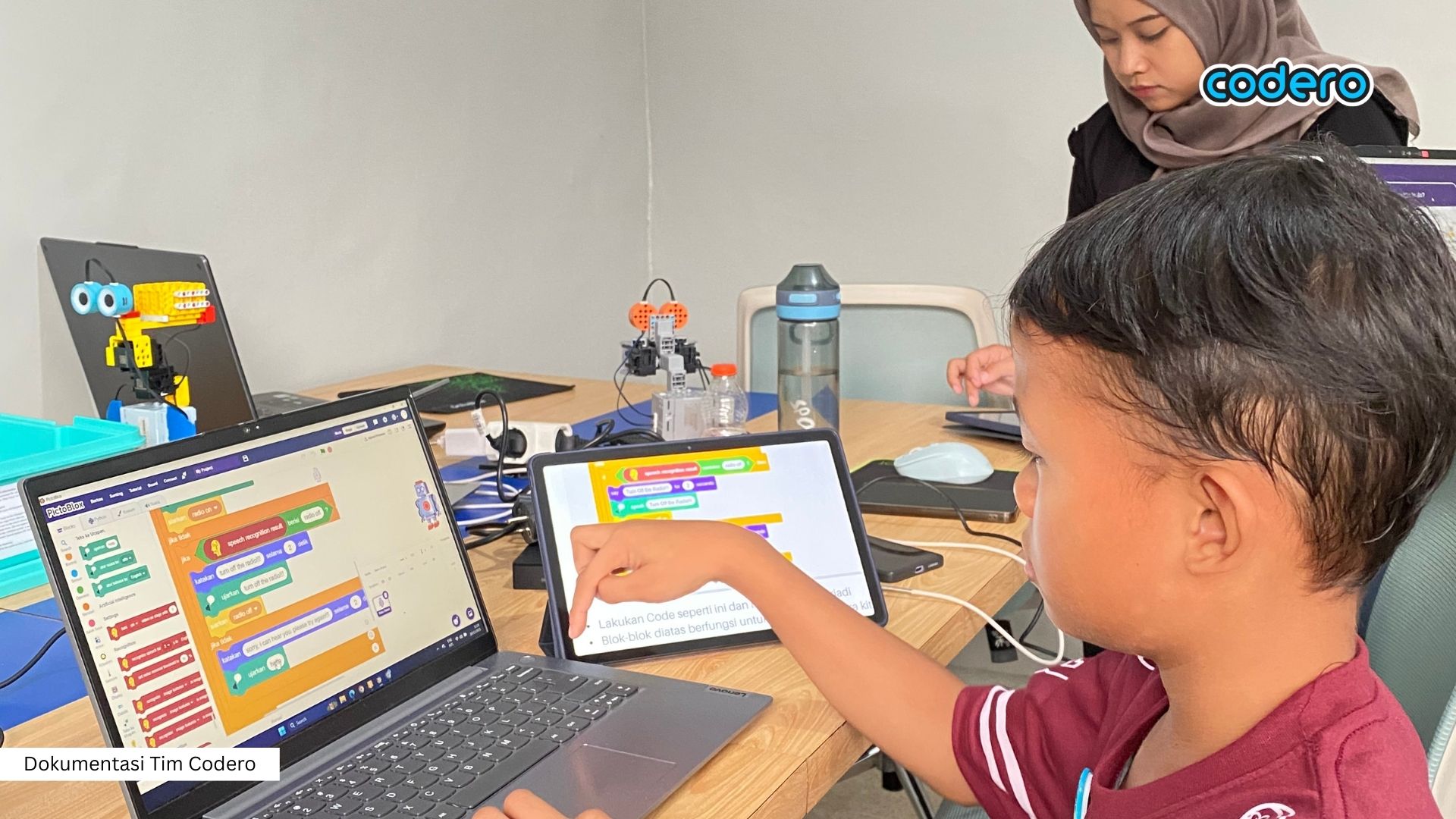
Often, the biggest challenges arise when programming logic does not align with mechanical design. However, this is where the magic happens. Heated discussions, even differences of opinion within the group, become catalysts for students' brain development.
They learn to negotiate and find middle ground to solve complex problems more efficiently. For them, errors are no longer obstacles, but puzzles to be solved together.
4. Instilling seeds of confidence and ownership
There is a different sparkle in their eyes when a robot successfully moves according to instructions for the first time. This success does not belong to individuals, but is a collective victory.
The sense of belonging to this project fosters a strong sense of confidence. They feel like they are part of something bigger—a community of learners who support each other.
Weaving the Future: The Strategic Role of CSR Synergy in Digital Literacy
In an era where technology moves faster than school curricula, the digital divide is a real challenge that we must face together. This is where you, as leaders and developers of CSR programs, play a crucial role. Companies are not merely providers of assistance, but bridges that connect the hidden potential of the nation's children with the realities of the future industry.
Through the right commitment, corporate involvement can touch on the following fundamental aspects:
1. Building foundations through digital infrastructure
Many schools in rural or disadvantaged areas have a high enthusiasm for learning but are hampered by limited resources. Your support in providing robotic devices and building computer labs is the first step in ensuring that no more talent is held back by facility constraints.
2. Empowering teachers as the spearhead
Educational transformation will not happen without competent teachers. Through CSR programs that focus on competency development—such as workshops and ongoing mentoring—we are investing in individuals who will guide thousands of students independently and innovatively in the future.
3. Mentoring: Bringing inspiration from the world of work
Imagine the impact on a student when they meet professionals from partner companies face to face. Through mentoring sessions, company employees can share insights into how coding and robotics are used in the real world. This is not just a transfer of knowledge, but an effort to ignite ambition from an early age.
4. Ensuring equality amid the technological revolution
Our main mission is inclusivity. CSR support ensures that children from underprivileged economic backgrounds and marginalized groups have equal access to digital literacy.
We want to ensure that technological advances belong to everyone, without anyone being left behind.
Realizing Codero's Shared Vision
Understanding the complexity of designing impactful programs, Codero is here as a strategic partner for you. We provide a structured coding and robotics curriculum, specifically designed to suit educational levels from elementary to high school.
This collaborative program is supported by trained educators who are ready to provide intensive learning assistance. We believe that learning technology should be an enjoyable and non-intimidating experience for students.
More than just social impact
For companies, this collaboration brings added value. In addition to strengthening their reputation and brand awareness in the eyes of the public, partners will gain:
National reach: The potential to expand the program's impact to schools throughout Indonesia.
Clear accountability: A systematic evaluation and monitoring system so that the program's effectiveness can be monitored transparently and measurably.
Let's discuss further to design a program that not only fulfills social responsibility but also creates a valuable legacy for future generations.
Consult your CSR collaboration plans here.
.jpg)
.jpg)
.jpg)
.jpg)
